

Copper-Binding Tripeptide
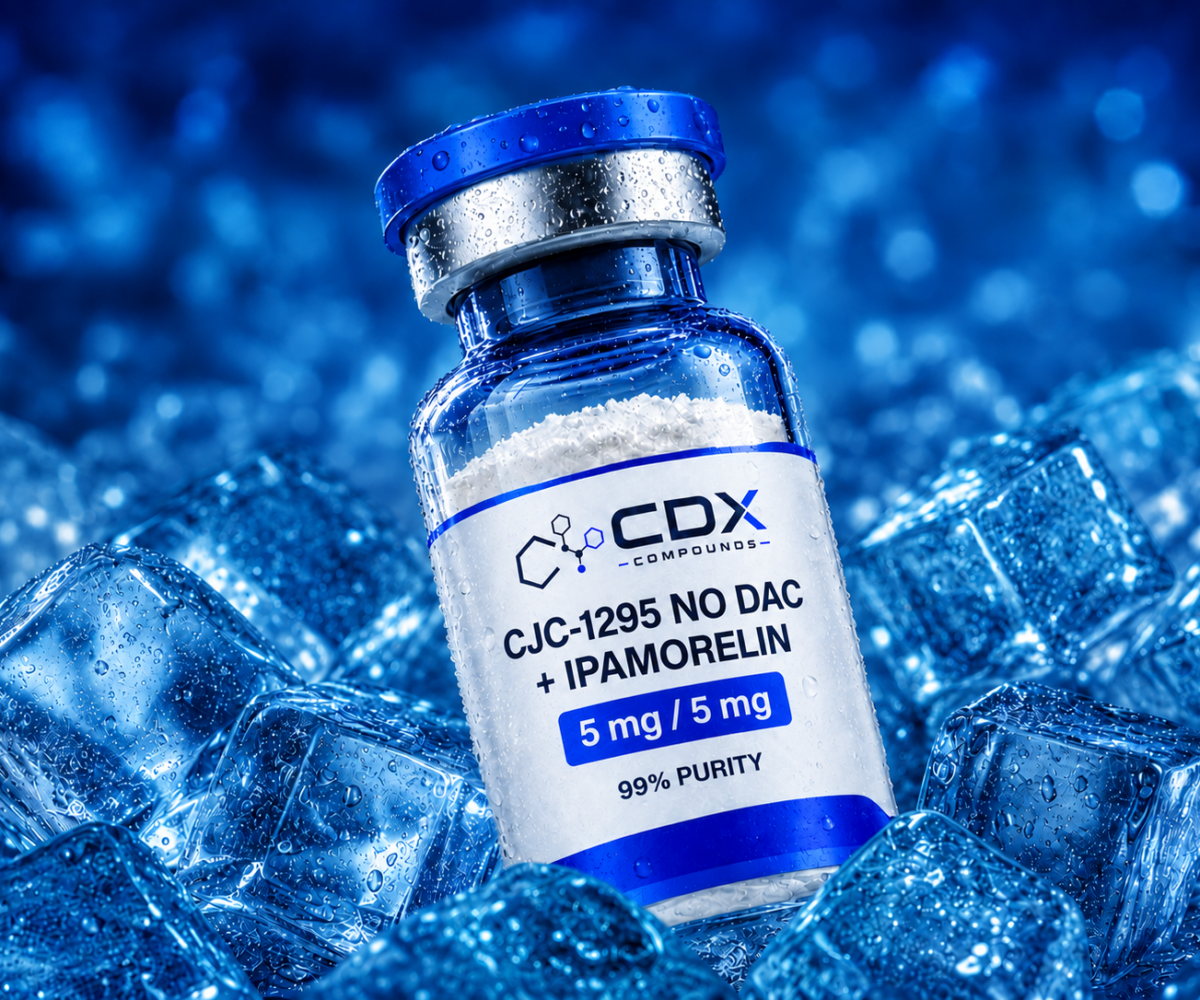
CJC/Ipamorelin No DAC 5mg/5mg
CJC-1295 No DAC + Ipamorelin combines two research peptides that interact with separate receptor systems associated with growth-hormone-axis signaling. The material commonly referred to as CJC-1295 No DAC is Modified...
Research Use Only — not for human or veterinary consumption. See our Research Use Only Policy for eligibility details.
CJC-1295 No DAC + Ipamorelin combines two research peptides that interact with separate receptor systems associated with growth-hormone-axis signaling.
The material commonly referred to as CJC-1295 No DAC is Modified GRF (1-29), a GHRH analog investigated through GHRH-receptor signaling. Ipamorelin is a synthetic pentapeptide secretagogue investigated primarily through the ghrelin receptor, GHS-R1a.
The blend provides a laboratory model for investigating interactions between these two receptor pathways.
Specifications
Product Classification: Research Use Only (RUO)
Total Content: 10 mg total per vial
Blend Composition: 5 mg CJC-1295 No DAC + 5 mg Ipamorelin
Compound 1: Modified GRF (1-29) / CJC-1295 No DAC
Compound 2: Ipamorelin
DAC: None
Form: Lyophilized peptide research blend
Packaging: Research vial
Purity: ≥99% (include only when supported by applicable batch documentation)
Intended Use: Laboratory research and analytical purposes only
Research Applications
The blend may be used in controlled laboratory models investigating:
- GHRH receptor signaling
- GHS-R1a signaling
- Ghrelin-receptor pathways
- Pituitary signaling models
- Secretagogue pathway research
- Dual-receptor interactions
- Growth-hormone-axis signaling
Warning
FOR RESEARCH USE ONLY. NOT FOR HUMAN OR VETERINARY USE. NOT FOR HUMAN CONSUMPTION.
This product is intended solely for qualified laboratory research and analytical applications.
Scientific Report
Abstract
Modified GRF (1-29) and Ipamorelin interact with separate receptor systems associated with growth-hormone-axis signaling.
Modified GRF (1-29) is investigated primarily through the GHRH receptor, while Ipamorelin is investigated as an agonist of GHS-R1a. Combining these research compounds provides a model for studying interactions between two mechanistically distinct signaling pathways.
Mechanistic Pathways
Modified GRF (1-29) / GHRH Receptor
Modified GRF (1-29) is a modified analog of the biologically active region of GHRH.
Research focus: GHRH-receptor activation and associated downstream signaling.
Ipamorelin / GHS-R1a
Ipamorelin is a synthetic pentapeptide investigated for agonist activity at GHS-R1a, also known as the ghrelin receptor.
Research focus: GHS-R1a receptor activation and associated signaling.
Dual-Pathway Interaction
Because the compounds interact with separate receptor systems, the blend can be investigated as a dual-pathway molecular model.
Research focus: Interactions between GHRH-receptor and GHS-R1a-associated signaling.
Research Profile
Compound 1: Modified GRF (1-29) / CJC-1295 No DAC
Primary Pathway: GHRH receptor
Compound 2: Ipamorelin
Primary Pathway: GHS-R1a / ghrelin receptor
Blend Composition: 5 mg / 5 mg
Primary Research Area: Dual-pathway signaling
Research Setting: Controlled laboratory and preclinical models
Research Parameters
Experimental conditions should be determined according to the laboratory model, assay methodology, and research endpoint. Appropriate controls and validated experimental protocols should be used.
No human or veterinary dosing, preparation, reconstitution, administration, or consumption instructions are provided.
Research Highlights
- GHRH-receptor signaling
- GHS-R1a receptor signaling
- Ghrelin-receptor research
- Pituitary signaling models
- Secretagogue pathway research
- Dual-pathway interactions
Conclusion
The 5 mg / 5 mg CJC-1295 No DAC + Ipamorelin blend provides two distinct molecular research tools within one preparation. Modified GRF (1-29) represents the GHRH-receptor component, while Ipamorelin represents the GHS-R1a component, allowing their respective signaling pathways and interactions to be investigated under controlled laboratory conditions.
Research Use Only — not for human or veterinary consumption.
Please review our Research Use Only Policy for eligibility details.